Transition to a Hydrogen Energy-Based Society
Generation of Demand for Hydrogen Energy
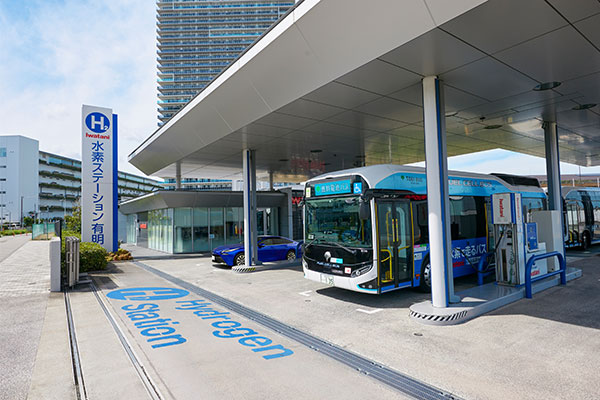
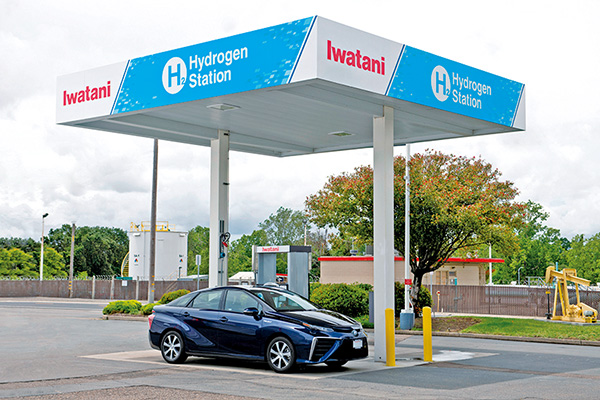
Having set the goal of swiftly building a hydrogen energy-based society-one based on the widespread use of fuel cell vehicles (FCVs) Iwatani is moving forward to develop hydrogen refueling stations across Japan.
These stations will serve as essential components of a supply infrastructure that supports the wider use of hydrogen. (As of April, 2026, we operated 52 stations in Japan and ten in the United States.)
We opened new hydrogen refueling stations in Ashigara (in September 2023) and Heiwajima (in April 2024), locations where demand for refueling commercial FCVs is high. We will continue to proactively roll out refueling stations for commercial FCVs in locations where demand for refueling is expected to grow.
In addition, the range of hydrogen applications is expected to expand beyond FCVs and FC trucks to other modes of transportation and mobility, including construction and mining machinery, port equipment, marine craft, and trains. While rolling out hydrogen refueling stations, we will advance the development of state-of-the-art technologies to meet the demand for hydrogen in a wide range of applications.

Japan Hydrogen Association (JH2A)
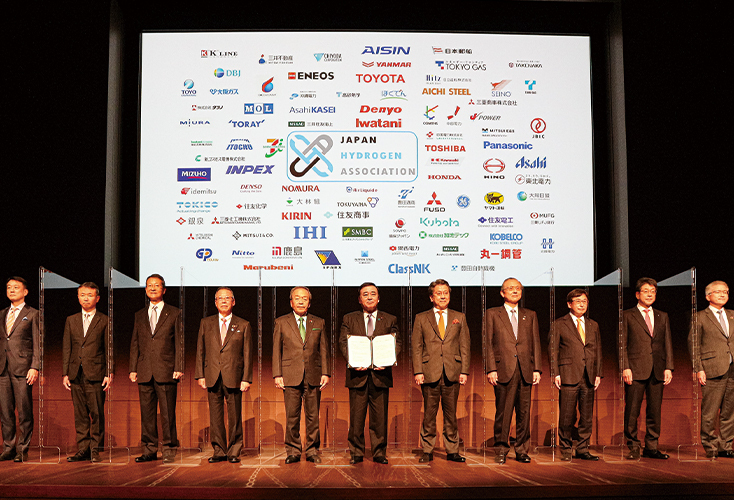
Established in December 2020 to develop a hydrogen-based society earlier through various practical projects, the Japan Hydrogen Association (JH2A) started operation as a general incorporated association in April 2022. With a membership of 526 companies as of November 2025, including not just energy suppliers, automakers, and manufacturers of various types of related equipment but banks, securities firms, and insurers, the JH2A is a truly nationwide organization.
Through the activities of various committees and sub-working groups, JH2A is advancing initiatives including the creation of social implementation projects, demand generation, policy proposals for deregulation, and the promotion of hydrogen-related investments. As a JH2A co-chair, Iwatani will continue to promote proactive activities alongside JH2A members.
Activity details
Commercialization Committee
The Commercialization Committee works to form social implementation projects and advance efforts toward commercialization by 2030. Its activities include promoting projects and developing tools to support project examination.
Regulatory Committee
The Regulatory Committee addresses regulatory issues necessary for the social implementation of hydrogen. It engages in coordination with government agencies and related organizations through efforts such as identifying issues from the results of questionnaires to businesses and sub-working group deliberations.
External Relations Committee
The External Relations Committee works to foster broader recognition and expectations for hydrogen by holding seminars and roundtable discussions for members, participating in exhibitions, and concluding memoranda of understanding with organizations overseas.
CO2 Free H2 Committee
To advance the social implementation of hydrogen, the CO2 Free H2 Committee engages in activities related to ISO standardization and certification frameworks, including the design of GHG emissions calculation methods, criteria, and systems, international negotiations, issue identification and clarification, and policy proposals.
Finance Committee
The Finance Committee works to enable fundraising for hydrogen-related projects. It undertakes efforts to invigorate the Japan Hydrogen Fund, launched in 2024, conducts research on the hydrogen market, and disseminates related information.
Hydrogen Council
Made up of over 141* leading companies from the energy, transport, and manufacturing sectors around the world, the Hydrogen Council seeks to achieve its shared goals by formulating recommendations for hydrogen use and effective action plans in joint efforts with policymakers, hydrogen-using businesses, international organizations, and citizens’ groups in various countries. As a member of the Hydrogen Council’s steering committee, Iwatani is active in efforts to expand use of hydrogen in Japan through sharing a global hydrogen vision.
- *As of December 2025
Japan H2 Mobility, LLC (JHyM)
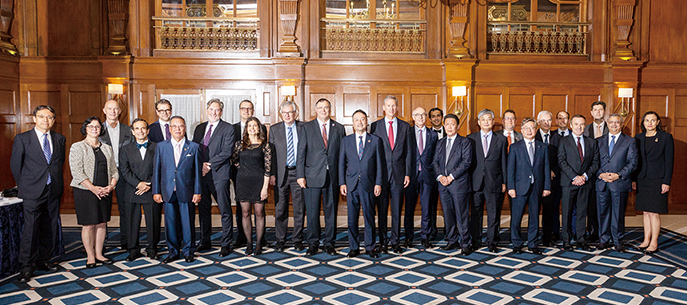
The JHyM was established in 2018 to develop and efficiently operate hydrogen refueling stations to serve fuel cell vehicles (FCVs) and promote their wider use. Current participants number 35 Japanese companies* drawn from the automotive, energy, and finance sectors, including Iwatani. Iwatani is active in building and operating hydrogen refueling stations and the standardization of related equipment and systems as part of efforts to enhance the hydrogen refueling station network.
- *As of April 2026
The Fukushima Plan for a New Energy Society
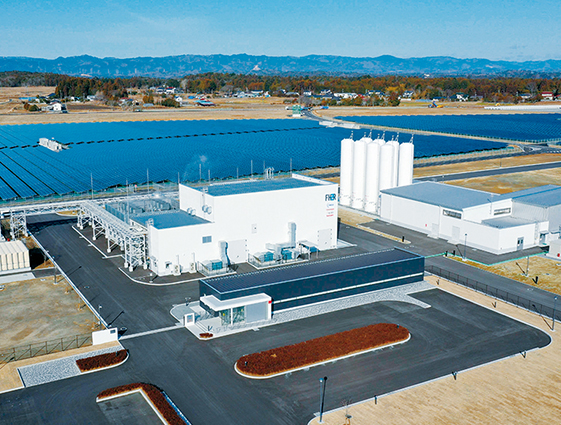
Iwatani also participates in the Fukushima Plan for a New Energy Society, an effort led by the Japanese government and Fukushima Prefecture to test the conversion of electricity generated from renewable energy into hydrogen for storage and use in local communities. In 2018, we built the Fukushima Hydrogen Energy Research Field facility in the town of Namie in Fukushima Prefecture.
Developed jointly with the New Energy and Industrial Technology Development Organization (NEDO), Toshiba Energy Systems & Solutions Corporation, Tohoku Electric Power, Tohoku Electric Power Network, and Asahi Kasei Corporation, this facility has the capacity to produce hydrogen equivalent to a 10,000-kW class power plant from solar power and other renewables (up to 2,000Nm3/hour). Feasibility testing began in FY2020. The hydrogen generated by this facility is used for fuel cell power generation and supplied to hydrogen refueling stations, primarily in Fukushima Prefecture.
Iwatani Hydrogen Energy Forum
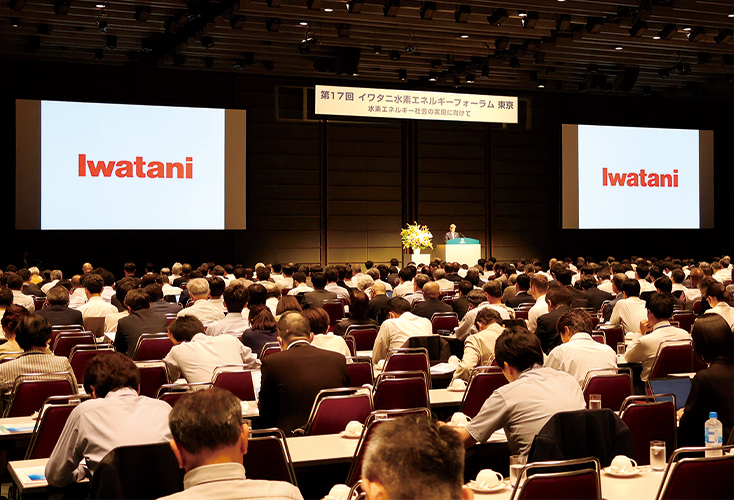
Since 2006, Iwatani has hosted the Iwatani Hydrogen Energy Forum at two venues, in Osaka and Tokyo. These events seek to deepen understanding of the various aspects of a hydrogen energy-based society and provide opportunities for networking to catalyze a shift toward such society. Each forum includes special lectures and Q&A sessions among participants intended to accelerate the widespread use of hydrogen energy.