
Conservation of Biodiversity and Ecosystem
Our Policy
Our business activities depend on a wide range of ecosystem services based on natural resources—air, water, and soil. Protecting biodiversity and ecosystems is a key issue in realizing a sustainable society. Through our business activities, the Iwatani Group helps safeguard biodiversity and ecosystems, including local ecosystems.
Biodiversity Initiatives
The Iwatani Group’s business activities are highly dependent on the fruits of biodiversity—resulting from the diversity of creatures on the planet and their interactions. For this reason, we recognize consideration for protecting ecosystems and other environmental conservation efforts and maintenance and preservation of biodiversity to be important topics for the Group.
For business activities that may significantly impact biodiversity, we first ascertain what kinds of biodiversity they depend on and what the impacts are, and then strive to minimize and contribute to recovery from such impacts on ecosystems.
Locating points of contact with nature (identifying dependencies and impacts)
Based on the TNFD’s*1 required LEAP approach*2, we started with the Locate process to analyze nature-related risks and opportunities in Iwatani Group businesses. We used the ENCORE*3 nature-related risk assessment tool to verify how our businesses depend on natural capital and how they might impact it.
Identifying points of contact with nature in the Iwatani Group’s main businesses (high-impact businesses)
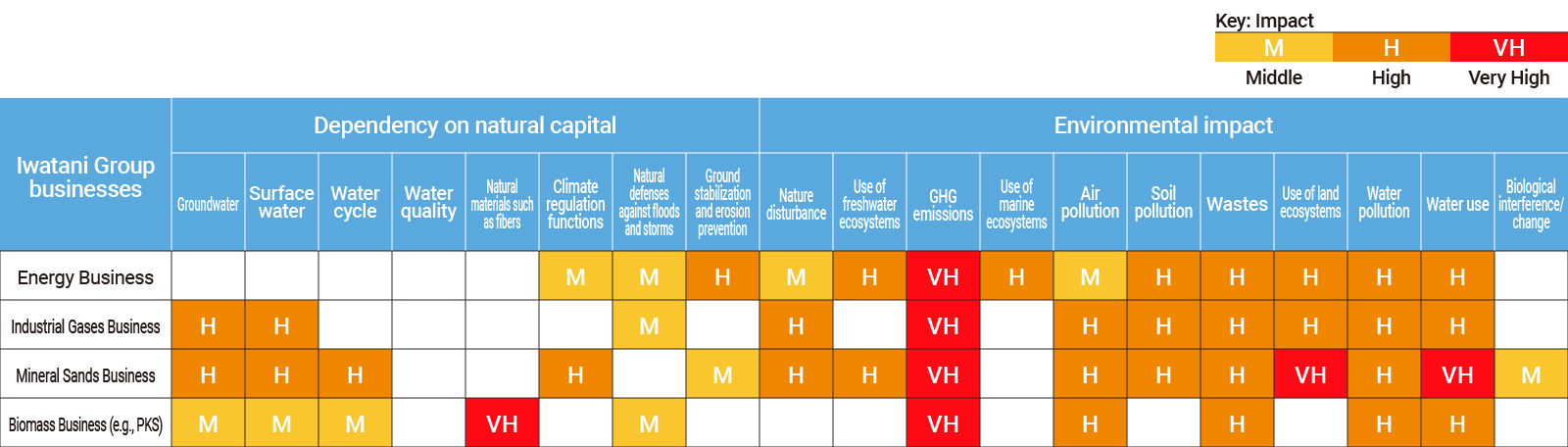
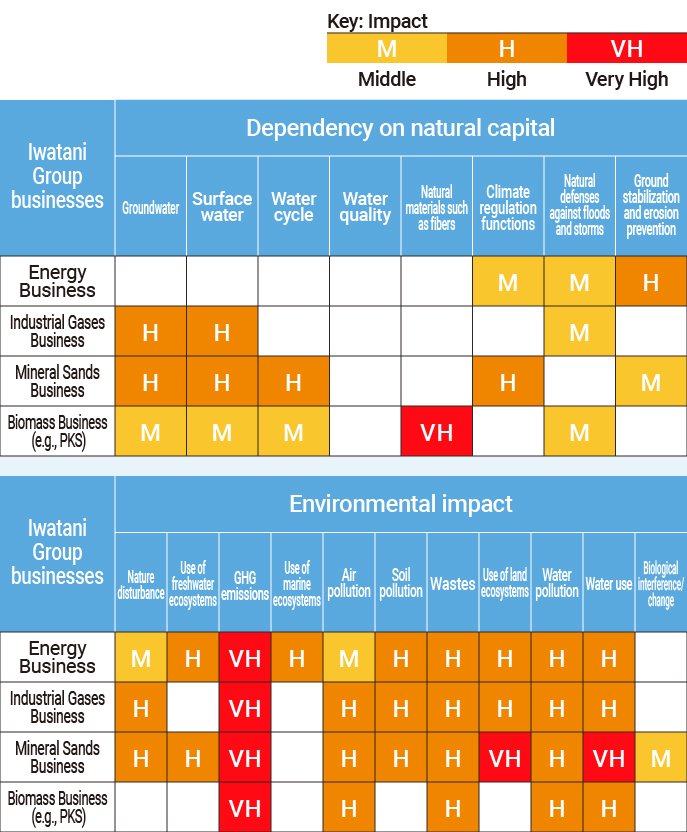
Results of ENCORE analysis showed that among our dependencies on natural capital (dependencies on ecosystem services), a tendency was observed that the biomass business, such as PKS, depends on nature-derived materials, while the mineral sands business relies on water supply services. In terms of our impacts on the environment, the Energy Business, Industrial Gases Business, Mineral Sands Business, and Biomass Business were all quite likely to generate major environmental impacts through GHG emissions and water use. Going forward, we will conduct detailed analyses based on the specific conditions of the regions in which we do business, and use this information to develop initiatives aimed at preserving biodiversity.
- *1 Iwatani supports the Taskforce on Nature-related Financial Disclosures (TNFD), an international initiative that provides a framework for businesses and financial institutions to identify, assess, and disclose risks and opportunities related to natural capital. TNFD aims to visualize relations with nature from a financial perspective and to encourage sustainable decision-making.
- *2 Integrated approach to assessments of nature-related issues, including points of contact with nature in business activities and their dependency relationship with nature, impact, risks, and opportunities, developed by the TNFD. Its process consists of the following steps: Locate; Evaluate; Assess; and Prepare.
- *3 Tool for identifying nature-related risks, developed chiefly by the United Nations Environment Programme World Conservation Monitoring Centre
Environmental Initiatives Through Business Activities
Donating to the Association of National Trusts in Japan Through ALALA
The ALALA series of natural detergents is made using natural palm oil, which is more biodegradable than petroleum products, and is decomposed easily in the sea and rivers. To protect precious natural resources, these products reflect a focus on eco-friendliness. A portion of their sales is donated to the Association of National Trusts in Japan to help preserve natural ecosystems.

Restoring Mining Sites to Their Original Condition (Australia)
Iwatani Australia Pty Ltd., a group member company, operates its mineral sands mining sites in ways that minimize environmental impact and protect local environments. Specific measures include installing protective barriers to reduce noise and dust from mining work and restoring sites to their original condition after mining.
Green Gold Label (GGL) Earned
In December 2021, Iwatani earned GGL certification, an independent certification program for biomass fuels.